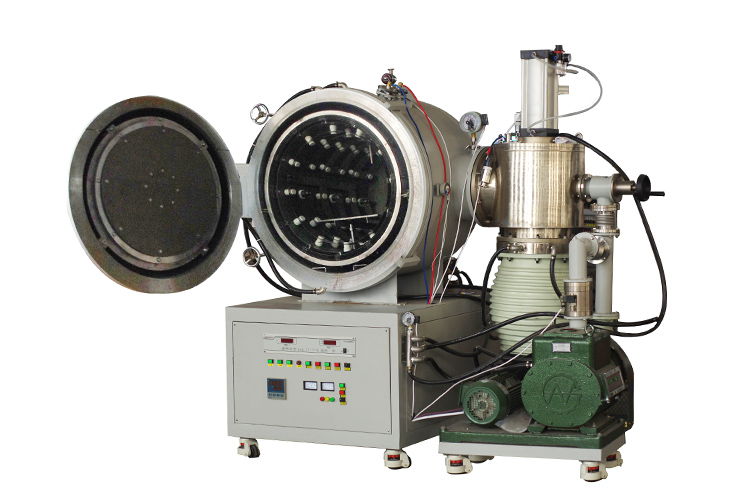
An industrial vacuum brazing furnace is a high-precision thermal processing system used to join metal components in a controlled vacuum environment. By eliminating oxygen and atmospheric contamination, vacuum brazing produces clean, strong, and repeatable metallurgical joints without the need for flux or extensive post-processing.
Brother Furnace vacuum brazing equipment is designed for high-reliability brazing of stainless steel, nickel alloys, carbide tools, and heat exchanger assemblies. With stable high-vacuum performance, uniform temperature distribution, and programmable heating cycles, our furnaces are widely used in aerospace, automotive, tooling, and advanced manufacturing industries.
Vacuum brazing furnaces provide a controlled environment where complex assemblies or multiple components can be processed simultaneously with consistent joint quality and minimal distortion.
Industrial Vacuum Brazing Furnace Features
- High vacuum capability up to 7 × 10⁻⁴ Pa
- Uniform furnace heating for consistent brazing quality
- PLC programmable temperature control with multi-segment heating profiles
- Custom chamber sizes for laboratory and industrial production
- Stable process repeatability for complex multi-component assemblies
These capabilities allow manufacturers to achieve reliable brazed joints in demanding applications such as aerospace components, heat exchangers, and precision tooling.
Vacuum Brazing Furnace Structure
A typical industrial vacuum brazing furnace consists of several integrated subsystems designed to ensure stable vacuum performance and precise thermal control.
- Vacuum chamber — Provides a sealed environment where oxygen and contaminants are removed.
- Heating system — Uses alloy heaters, heating wires, or molybdenum heating elements depending on the temperature range.
- Vacuum pumping system — Mechanical and diffusion pumps create the required high-vacuum environment.
- Temperature control system — PLC programmable control ensures accurate heating profiles and repeatable brazing cycles.
- Cooling system — Controlled cooling maintains dimensional accuracy and prevents thermal distortion.
Vacuum Brazing Furnace Overview
The following video presents the exterior structure and chamber configuration of a vacuum brazing furnace, illustrating its industrial design and system layout.

Vacuum Brazing Furnace Working Principle
A vacuum brazing furnace heats metal assemblies inside a sealed chamber to a temperature above the brazing filler metal’s melting point but below that of the base materials.
During heating, molten filler metal flows into joint gaps through capillary action, forming a strong metallurgical bond between the components. Because the process occurs in a high-vacuum environment, oxidation and contamination are minimized, allowing high-quality joints to be produced without flux or surface oxidation.
Vacuum Brazing Process
The brazing process typically includes five key stages:
- Preparation — Components are cleaned to remove oils, oxides, and contaminants before assembly.
- Vacuum Evacuation — Air and gases are removed from the chamber to create a stable high-vacuum environment.
- Heating — The furnace heats the assembly uniformly to the required brazing temperature.
- Brazing — The filler metal melts and flows into the joint clearance through capillary action.
- Cooling — Controlled cooling preserves joint integrity and dimensional accuracy.
Advantages of Vacuum Brazing
- Oxidation-free joints with no flux residue
- Excellent repeatability across production batches
- Minimal thermal distortion due to uniform heating
- Compatibility with dissimilar metals and precision components
- Reduced post-processing and cleaner finished parts
- Environmentally friendly process without corrosive flux chemicals
Vacuum Brazing vs Conventional Brazing
| Parameter | Vacuum Brazing | Conventional Brazing |
|---|---|---|
| Atmosphere | High vacuum environment | Air or protective gas |
| Oxidation | Minimal oxidation | Surface oxidation common |
| Flux Requirement | No flux required | Flux usually required |
| Joint Cleanliness | Bright and clean joints | Flux residue may remain |
| Distortion | Uniform heating reduces distortion | Localized heating may cause distortion |
| Repeatability | Highly repeatable process | More dependent on operator skill |
Vacuum Brazing Applications
- Aerospace structural components and assemblies
- Automotive heat exchangers and multi-part systems
- CBN and PCD cutting tools
- Stainless steel and copper alloy components
- Heat exchanger cores and precision fluid systems
The vacuum environment allows large assemblies or multiple parts to be brazed in a single furnace cycle, ensuring consistent quality and efficient production.
Industries Using Vacuum Brazing Furnaces
- Aerospace manufacturing — turbine components and structural assemblies
- Automotive industry — EGR coolers and stainless steel heat exchangers
- Cutting tool manufacturing — brazing CBN and PCD inserts
- Electronics and power devices — precision metal joining
- HVAC systems — brazed heat exchangers and cooling systems
Materials Suitable for Vacuum Brazing
- Stainless steel (300 and 400 series)
- Nickel-based superalloys
- Copper and copper alloys
- Tool steels and carbide components
- CBN and PCD cutting tools
Vacuum Brazing Furnace Models & Specifications
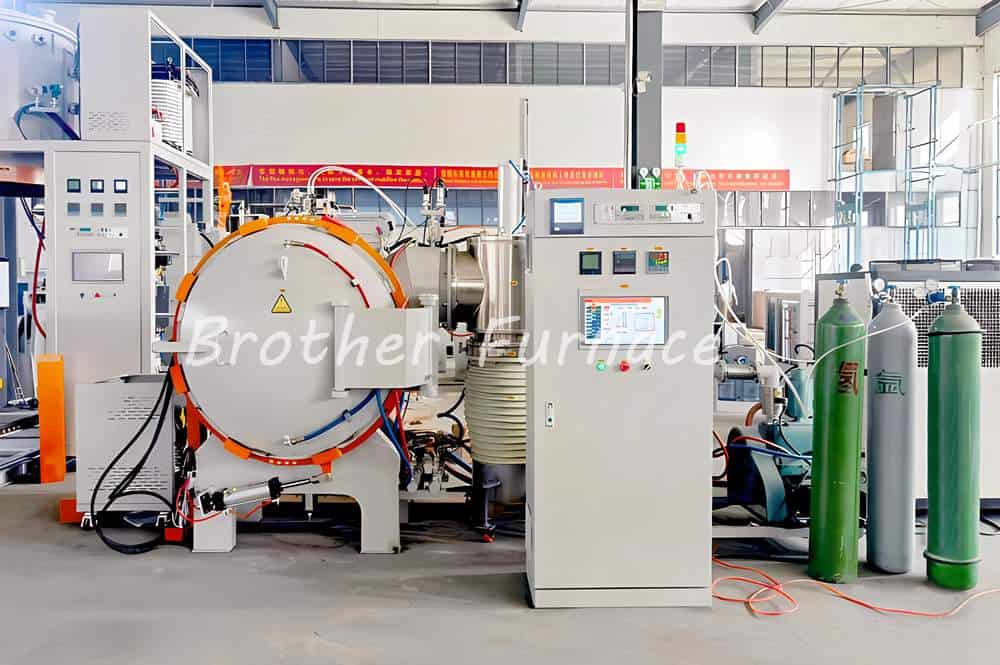
Brother Furnace vacuum brazing furnaces operate up to 1350°C as standard, with customizable configurations available up to 1500°C.
- PLC programmable temperature control
- High vacuum capability
- Multiple chamber size options
- Stable heating performance
- Flexible configurations for laboratory and production use

Technical Specifications
| Working Voltage | 380V 50Hz 3-Phase (or per customer standard) |
| Max Power Range | 3 kW – 180 kW |
| Temperature Accuracy | ±1°C |
| Heating Rate | ≤20°C/min |
| Thermocouple Type | K / S type |
| Maximum Vacuum | 7 × 10⁻⁴ Pa |
| Working Vacuum | 7 × 10⁻³ Pa |
| Temperature Control | PLC or programmable PID control |
Working Temperature vs Chamber Configuration
Different vacuum brazing furnace configurations are designed for different temperature ranges and heating element materials. The table below shows typical chamber structures used for various operating temperatures.
| Working Temperature | Heater Type | Chamber Material |
|---|---|---|
| 750°C | Alloy tube heaters | Stainless steel sheets |
| 1100°C | Heating wires | Ceramic fiberboard |
| 1350°C | Molybdenum strap heaters | Molybdenum + stainless steel sheets |
| 1500°C | Customizable | Customizable |
Standard Vacuum Brazing Furnace Models
Brother Furnace offers a range of standard vacuum brazing furnace models. Custom chamber sizes and configurations are also available depending on the application.
Stainless Steel Chamber — Up to 750°C
| Model | Chamber Size | Max Temp | Power | Voltage | Vacuum |
|---|---|---|---|---|---|
| BR-QHS-223 | 200×200×300 mm | 750°C | 12 kW | 380V | 7×10⁻³ Pa (7×10⁻⁵ mbar) |
| BR-QHS-334 | 300×300×400 mm | 750°C | 21 kW | 380V | |
| BR-QHS-446 | 400×400×600 mm | 750°C | 34 kW | 380V | |
| BR-QHS-557 | 500×500×700 mm | 750°C | 46 kW | 380V | |
| BR-QHS-669 | 600×600×900 mm | 750°C | 64 kW | 380V |
Ceramic Fiber Chamber — Up to 1200°C
| Model | Chamber Size | Max Temp | Power | Voltage | Vacuum |
|---|---|---|---|---|---|
| BR-200BF | Dia. 200×400 mm | 1200°C | 8 kW | 380V | 7×10⁻³ Pa (7×10⁻⁵ mbar) |
Molybdenum Chamber — Up to 1350°C
| Model | Chamber Size | Max Temp | Power | Voltage | Vacuum |
|---|---|---|---|---|---|
| BR-QHM-223 | 200×200×300 mm | 1350°C | 34 kW | 380V | 7×10⁻³ Pa (7×10⁻⁵ mbar) |
| BR-QHM-334 | 300×300×400 mm | 1350°C | 60 kW | 380V | |
| BR-QHM-446 | 400×400×600 mm | 1350°C | 98 kW | 380V | |
| BR-QHM-557 | 500×500×700 mm | 1350°C | 132 kW | 380V | |
| BR-QHM-669 | 600×600×900 mm | 1350°C | 180 kW | 380V |
How to Choose the Right Vacuum Brazing Furnace
Selecting the right vacuum brazing furnace depends on several technical factors including temperature, chamber size, vacuum level, and production capacity.
Working with an experienced vacuum brazing furnace manufacturer ensures the furnace configuration matches the specific application requirements.
Get a Quote
Need a vacuum brazing furnace for your application?
Share your material type, chamber size, and temperature requirements and our engineers will recommend the most suitable furnace configuration.
Contact us for a quotation or technical consultation.
Vacuum Brazing Tips
For a deeper understanding of how vacuum brazing furnaces work, materials compatibility, and filler metal selection, see our: Vacuum Brazing Furnace Guide.
Achieving high-quality brazed joints depends on proper material preparation, joint design, and precise process control. To learn more about surface cleanliness, joint clearance, heating uniformity, and cooling control, see our detailed guide: Vacuum Brazing: How to Achieve High-Quality Brazed Joints
FAQ – Vacuum Brazing Furnace
What metals can be brazed in a vacuum brazing furnace?
Stainless steel, copper, nickel alloys, tool steels, and select carbide-based materials can all be vacuum brazed using appropriate filler metals.
Why choose vacuum brazing over conventional brazing?
Vacuum brazing prevents oxidation, eliminates flux, and produces cleaner, stronger joints with minimal post-processing — making it ideal for precision and high-reliability applications.
Can vacuum brazing handle complex or dissimilar part geometries?
Yes. The controlled vacuum environment supports joining of complex shapes and dissimilar material combinations with high joint integrity and minimal distortion.
How do I select the right chamber temperature for my application?
It depends on your base metal and filler metal combination. For example, copper brazing typically requires around 1100°C, while diamond tool brazing may need up to 1350°C. Our team can help match the furnace specification to your process requirements.
What vacuum level is needed for brazing stainless steel or copper alloys?
A working vacuum of 7×10⁻³ Pa is sufficient for most stainless steel and copper alloy applications. For more sensitive or reactive materials, higher vacuum levels (up to 7×10⁻⁴ Pa) may be recommended.
How important is part cleanliness before vacuum brazing?
Cleanliness is critical. Oils, oxides, and surface contaminants can prevent proper filler metal flow and weaken joint quality. All parts should be thoroughly degreased and dried before loading.
How long does a typical vacuum brazing cycle take?
Cycle time depends on the material, part mass, and temperature profile. A typical cycle — including ramp-up, brazing hold, and controlled cooling — ranges from 2 to 6 hours.
Can the furnace run unattended overnight?
Yes. With PLC-based programmable control, over-temperature alarms, and thermocouple fault detection, the furnace can execute multi-segment programs safely with minimal operator supervision.
Related Vacuum Furnace Products
- Aluminum Brazing Vacuum Furnace
- High Temperature Vacuum Furnace
- AI Liquid Cold Plate Vacuum Brazing Furnace
Follow us on Facebook