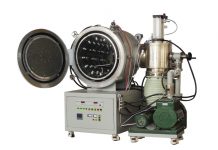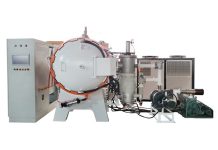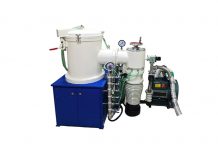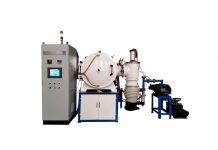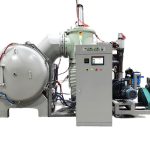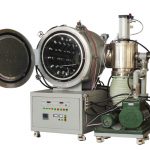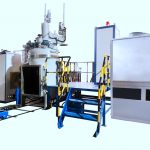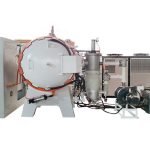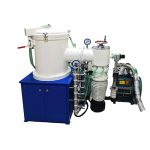
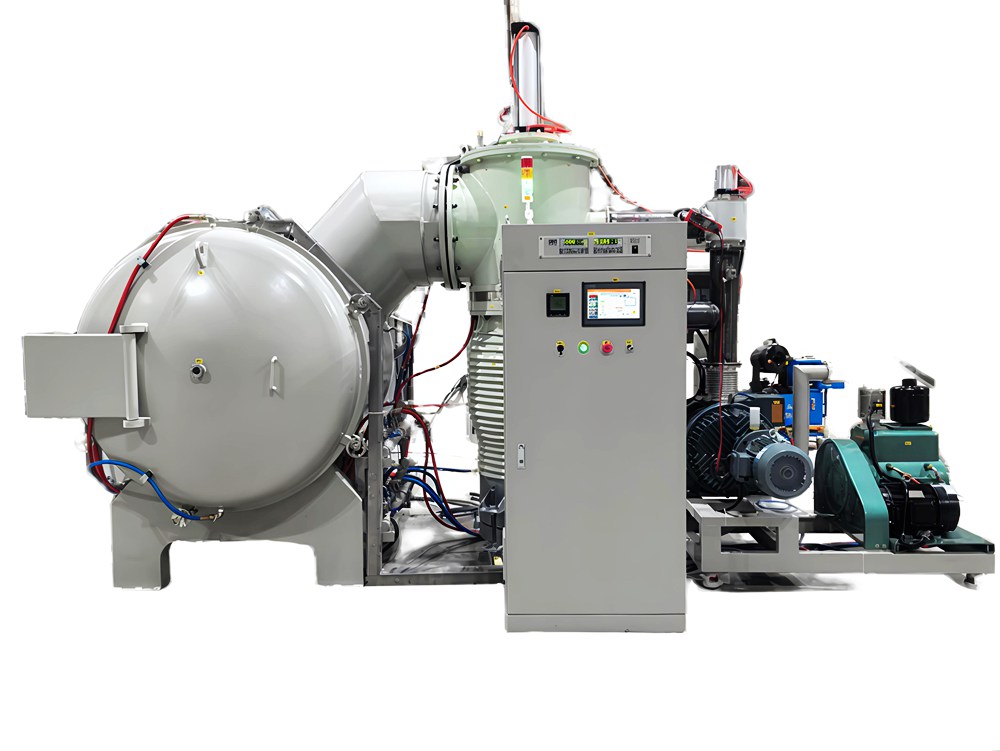
A high temperature vacuum furnace is a sealed thermal processing system capable of reaching extreme temperatures — from 1200℃ up to 2200℃ — in a controlled vacuum environment. By removing oxygen and reactive gases from the chamber, these furnaces enable precision sintering, brazing, annealing, hardening, and degassing of advanced materials without oxidation, contamination, or surface degradation.
Brother Furnace high temperature vacuum furnaces are available in four heating element configurations — resistance wire, molybdenum foil, MoSi₂, and graphite — covering the full temperature spectrum required for refractory metals, advanced ceramics, superalloys, and hard material tooling. Maximum vacuum: 7×10⁻⁴ Pa. Chamber sizes from 1L bench-top to 324L production scale, with full customization available.
What Is a High Temperature Vacuum Furnace?
A high temperature vacuum furnace combines a high-performance heating system with a vacuum-tight chamber and pumping system to process materials at elevated temperatures in an oxygen-free environment. Unlike conventional atmosphere furnaces, the vacuum environment actively removes surface oxides, prevents new oxidation, and eliminates the need for protective gas or flux.
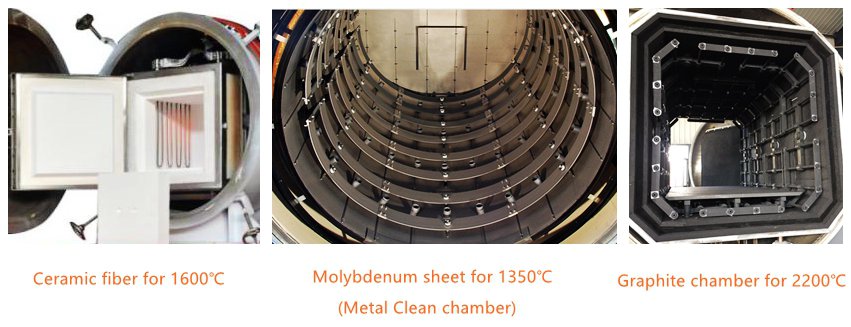
The defining characteristic is the heating element and hot-zone construction, which determines the maximum operating temperature and the materials that can be processed. Brother furnaces offer four distinct configurations, each optimized for a specific temperature range and application profile.
Four Heating Configurations: Which One Do You Need?
1. Resistance Wire — Up to 1200℃
Resistance wire heating elements (typically FeCrAl or NiCr alloy) in a ceramic fiber hot zone provide a cost-effective solution for vacuum heat treatment, low-temperature brazing, and annealing of stainless steel, copper alloys, and tool steels. Fast heat-up, low operating cost, and easy maintenance make this configuration the standard choice for laboratory and R&D applications.
Typical applications: vacuum annealing of stainless steel and copper, silver-based vacuum brazing (BAg series, 600–900℃), outgassing of electronic components, low-temperature vacuum hardening of die steels.
Thermocouple: S type | Vacuum pump: mechanical + diffusion pump (7×10⁻³ Pa working vacuum)
2. Molybdenum Foil — Up to 1350℃
Molybdenum strap heating elements with a molybdenum and stainless steel composite hot zone deliver superior temperature uniformity at mid-range high temperatures. This is the workhorse configuration for vacuum brazing of nickel superalloys, tool steel hardening, and sintering of cemented carbide compacts.
Typical applications: nickel-based filler brazing (BNi series, 970–1150℃), vacuum hardening of M2/M42 high-speed steels, carbide pre-sintering, vacuum tempering of H13 and D2 tool steels, CBN/PCD tool brazing with Ag-Cu-Ti active alloys.
Thermocouple: S type | Maximum vacuum: 7×10⁻⁴ Pa
3. MoSi₂ Heating Elements — Up to 1700℃
Molybdenum disilicide (MoSi₂) heating elements with a ceramic fiber hot zone push into the temperature range required for advanced technical ceramics, refractory metal processing, and high-temperature sintering. MoSi₂ elements form a self-healing SiO₂ protective layer in oxidizing conditions, but in vacuum they deliver clean, stable performance up to 1700℃ with excellent long-term reliability.
Typical applications: sintering of alumina (Al₂O₃), zirconia (ZrO₂), silicon carbide (SiC), and silicon nitride (Si₃N₄) ceramics; vacuum annealing of molybdenum and tungsten components; high-temperature diffusion bonding; aerospace superalloy heat treatment; debinding and sintering of MIM (metal injection molded) parts.
Thermocouple: B type | Chamber insulation: high-purity ceramic fiber board
4. Graphite Heating Elements — Up to 2200℃
Graphite resistance heating elements with a carbon felt insulation hot zone reach the highest temperatures available in laboratory and production vacuum furnaces. At 2200℃, this configuration covers the full processing range of ultra-refractory materials including tungsten, rhenium, hafnium carbide, and boron carbide — materials that cannot be processed in any other furnace type.
Typical applications: sintering of tungsten carbide (WC-Co) hard metals, ultra-high temperature ceramic sintering (HfC, TaC, ZrB₂), carbon fiber and carbon-carbon composite processing, rare earth permanent magnet sintering (NdFeB, SmCo), refractory metal annealing (W, Mo, Re), SPS/spark plasma sintering research, high-temperature diffusion studies.
Thermocouple: W-Re type | Note: graphite hot zone requires inert gas or vacuum atmosphere — not compatible with oxidizing or sulfur-containing gases.
High Temperature Vacuum Furnace vs. Atmosphere Furnace
| Parameter | High Temperature Vacuum Furnace | High Temperature Atmosphere Furnace |
|---|---|---|
| Atmosphere | High vacuum (10⁻³–10⁻⁴ Pa) | Air, N₂, H₂, Ar or mixed gas |
| Surface oxidation | None | Possible unless reducing atmosphere used |
| Contamination risk | Minimal — no gas-phase reactions | Gas purity and flow control critical |
| Max temperature | Up to 2200℃ (graphite) | Up to 1800℃ (MoSi₂ in air) |
| Part surface finish | Bright, clean, no scale | May require post-processing |
| Material compatibility | Ti, W, Mo, Re, carbides, nitrides, ceramics | Limited for reactive metals |
| Operating cost | Higher (vacuum system maintenance) | Lower |
| Best for | Precision parts, reactive metals, superalloys, hard materials | High-volume, less oxidation-sensitive materials |
Key Applications by Industry
Vacuum Sintering of Advanced Ceramics and Hard Metals
Sintering of cemented carbide (WC-Co), alumina, zirconia, silicon carbide, and silicon nitride requires precise temperature control in an oxygen-free environment to achieve full density without grain growth or surface contamination. Vacuum sintering produces components with superior mechanical properties compared to atmosphere sintering, particularly in terms of fracture toughness and hardness uniformity.
The graphite-element furnace (up to 2200℃) is the standard choice for WC-Co hard metal sintering (typical cycle: 1380–1450℃, 30–60 min hold), while the MoSi₂ configuration handles technical oxide ceramics in the 1400–1700℃ range.
Vacuum Heat Treatment of Tool Steels and High-Speed Steels
Vacuum hardening and tempering of M2, M42, H13, D2, and other tool steels produces bright, scale-free parts with minimal distortion — eliminating the post-treatment grinding and cleaning required after salt bath or atmosphere hardening. The vacuum environment also removes hydrogen and other embrittling gases from the steel matrix during the heating cycle.
Typical hardening temperatures: H13 (1020–1050℃), M2 (1200–1240℃), D2 (1010–1040℃). Tempering at 500–600℃ can be performed in the same furnace immediately after quench-cooling.
Vacuum Brazing of Superalloys and Precision Assemblies
High temperature vacuum brazing of nickel and cobalt superalloy components — turbine blades, combustion chamber liners, honeycomb sandwich panels — requires furnace temperatures of 970–1200℃ at vacuum levels of 10⁻⁴ Pa or better. The molybdenum-element BR-QHM series and MoSi₂-element BR-17VF series are both used for this application, depending on the specific filler metal and substrate combination.
Nickel-based filler metals (BNi-2, BNi-5, BNi-7) are most commonly used. Joint clearances of 0.025–0.075 mm ensure complete capillary fill at brazing temperature.
Refractory Metal Processing (W, Mo, Re, Ta)
Tungsten, molybdenum, rhenium, and tantalum components for semiconductor equipment, X-ray targets, and defense applications must be annealed, stress-relieved, or sintered in vacuum at temperatures above 1600℃ to avoid embrittlement from oxygen pickup. The graphite-element furnace (up to 2200℃) is the only practical option for full annealing of tungsten (typically 1800–2000℃).
Rare Earth Permanent Magnet Sintering
NdFeB and SmCo permanent magnets are sintered in vacuum at 1050–1120℃ (NdFeB) and 1180–1220℃ (SmCo) to achieve full density and optimal magnetic properties. Atmosphere control is critical — even trace oxygen causes oxidation of the rare earth phases and catastrophic loss of coercivity. Both the molybdenum and MoSi₂ configurations are used for this application.
MIM (Metal Injection Molding) Debinding and Sintering
Metal injection molded parts require a two-stage thermal process: catalytic or thermal debinding to remove the polymer binder, followed by vacuum sintering at 1100–1400℃ to full density. The vacuum environment prevents carbon contamination from binder residues and ensures clean sintering of stainless steel, titanium, and superalloy MIM components.
Research, University, and R&D Laboratories
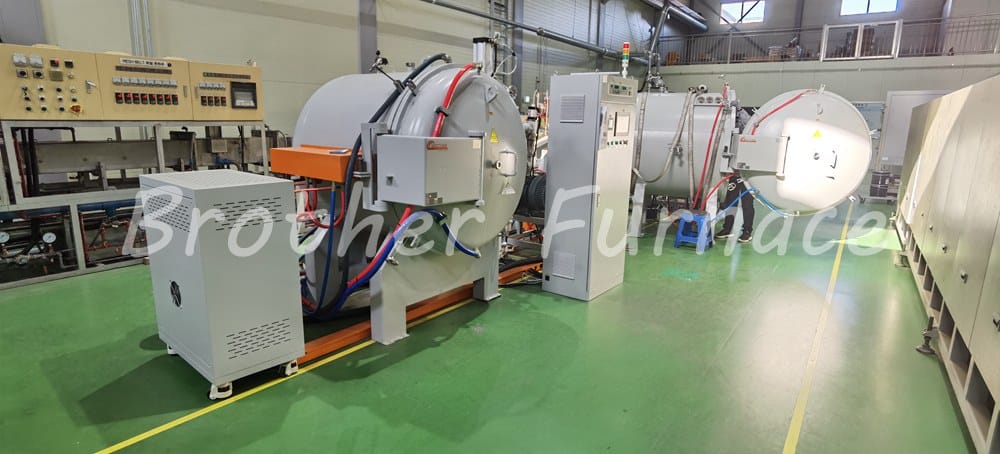
The bench-top BR-12HVF-1 (1L, 1200℃) and BR-22STV-20 (graphite, 2200℃) models are widely used in university materials science laboratories, national research institutes, and corporate R&D centers for sample preparation, phase diagram studies, thin film deposition substrate annealing, and novel material synthesis. Brother furnaces are in use at Tsinghua University, the Chinese Academy of Sciences, Xi’an Jiaotong University, Harbin Institute of Technology, and research institutions across Asia, Europe, and the Middle East.
Technical Specifications
| Max. Temperature | 1200℃ / 1350℃ / 1700℃ / 2200℃ (by configuration) |
| Maximum Vacuum | 7×10⁻⁴ Pa (mechanical + molecular pump) |
| Working Vacuum Options | 10 Pa (rotary pump) → 7×10⁻¹ Pa (rotary + Roots) → 7×10⁻³ Pa (rotary + diffusion) → 7×10⁻⁴ Pa (rotary + molecular) |
| Temperature Accuracy | ±1℃ |
| Heating Rate | ≤20℃/min (programmable) |
| Temperature Control | 51-segment programmable PID / PLC via SCR phase-angle power control; PID auto-tune function |
| Thermocouples | S type (≤1350℃) / B type (≤1700℃) / W-Re type (≤2200℃) |
| Optional Control | PC software control; touch screen controller |
| Alarms | Over-temperature, upper limit, deviation, broken thermocouple |
| Furnace Structure | Double-layer carbon steel casing with water cooling; outer surface ≤30℃; inner door — polished stainless steel |
| Power Supply | 380V 50Hz 3-phase (other standards available) |
| Power Range | 1.2 kW – 180 kW |
| Certifications | CE |
| Warranty | One year limited warranty with lifetime technical support |
Standard Models and Sizes
Resistance Wire — Up to 1200℃ (BR-12HVF Series)
Ceramic fiber insulation, FeCrAl or NiCr resistance wire heating elements. Ideal for laboratory vacuum heat treatment, low-temperature brazing, and annealing.
| Model | Chamber Size (W×H×D) | Capacity | Power | Max Vacuum |
|---|---|---|---|---|
| BR-12HVF-1 | 100×100×100 mm | 1 L | 1.2 kW | 7×10⁻³ Pa |
| BR-12HVF-5 | 150×150×200 mm | 4.5 L | 3.5 kW | 7×10⁻³ Pa |
| BR-12HVF-12 | 200×200×300 mm | 12 L | 5 kW | 7×10⁻³ Pa |
| BR-12HVF-36 | 300×300×400 mm | 36 L | 12 kW | 7×10⁻³ Pa |
| BR-12HVF-64 | 400×400×600 mm | 96 L | 24 kW | 7×10⁻³ Pa |
| BR-12HVF-125 | 500×500×700 mm | 175 L | 36 kW | 7×10⁻³ Pa |
| BR-12HVF-216 | 600×600×900 mm | 324 L | 56 kW | 7×10⁻³ Pa |
Molybdenum Foil — Up to 1350℃ (BR-QHM Series)
Molybdenum strap heating elements with Mo/stainless composite hot zone. The standard configuration for vacuum brazing of superalloys, tool steel hardening, and carbide processing.
| Model | Chamber Size | Max Temp. | Power | Max Vacuum |
|---|---|---|---|---|
| BR-QHM-223 | 200×200×300 mm | 1350℃ | 42 kW | 7×10⁻⁴ Pa |
| BR-QHM-334 | 300×300×400 mm | 1350℃ | 72 kW | 7×10⁻⁴ Pa |
| BR-QHM-446 | 400×400×600 mm | 1350℃ | 120 kW | 7×10⁻⁴ Pa |
| BR-QHM-557 | 500×500×700 mm | 1350℃ | 160 kW | 7×10⁻⁴ Pa |
| BR-QHM-669 | 600×600×900 mm | 1350℃ | 225 kW | 7×10⁻⁴ Pa |
MoSi₂ Heating Elements — Up to 1700℃ (BR-17VF Series)
MoSi₂ heating elements with high-purity ceramic fiber insulation. The preferred choice for advanced ceramic sintering, refractory metal annealing, and high-temperature R&D applications.
| Model | Chamber Size (W×H×D) | Capacity | Power | Max Vacuum |
|---|---|---|---|---|
| BR-17VF-1 | 100×100×100 mm | 1 L | 1.5 kW | 7×10⁻³ Pa |
| BR-17VF-5 | 150×150×200 mm | 4.5 L | 5 kW | 7×10⁻³ Pa |
| BR-17VF-12 | 200×200×300 mm | 12 L | 8 kW | 7×10⁻³ Pa |
| BR-17VF-36 | 300×300×400 mm | 36 L | 12 kW | 7×10⁻³ Pa |
| BR-17VF-80 | 400×400×600 mm | 96 L | 30 kW | 7×10⁻³ Pa |
| BR-17VF-175 | 500×500×700 mm | 175 L | 45 kW | 7×10⁻³ Pa |
| BR-17VF-324 | 600×600×900 mm | 324 L | 70 kW | 7×10⁻³ Pa |
Graphite Heating Elements — Up to 2200℃ (BR-22STV Series)
Graphite resistance elements with carbon felt insulation. The only configuration capable of processing ultra-refractory materials and reaching 2200℃. Available in cylindrical chamber geometry optimized for uniform temperature distribution at extreme temperatures.
| Model | Heating Zone (Dia. × Height) | Max Temp. | Power | Max Vacuum |
|---|---|---|---|---|
| BR-22STV-20 | Φ80×100 mm | 2200℃ | 20 kW | 7×10⁻³ Pa |
| BR-22STV-25 | Φ90×120 mm | 2200℃ | 25 kW | 7×10⁻³ Pa |
| BR-22STV-40 | Φ140×160 mm | 2200℃ | 40 kW | 7×10⁻³ Pa |
| BR-22STV-50 | Φ160×200 mm | 2200℃ | 50 kW | 7×10⁻³ Pa |
| BR-22STV-60 | Φ260×270 mm | 2200℃ | 60 kW | 7×10⁻³ Pa |
| BR-22STV-100 | Φ320×320 mm | 2200℃ | 100 kW | 7×10⁻³ Pa |
All chamber sizes can be customized. Larger production-scale furnaces available on request.
How to Select the Right High Temperature Vacuum Furnace
The right furnace configuration depends on four factors: required maximum temperature, material type, required vacuum level, and batch size. Use this guide as a starting point:
| Your Application | Required Temp. | Recommended Configuration |
|---|---|---|
| Stainless steel / copper alloy vacuum annealing | 800–1100℃ | BR-12HVF (resistance wire) |
| Silver-based vacuum brazing (BAg fillers) | 700–900℃ | BR-12HVF (resistance wire) |
| Tool steel vacuum hardening (H13, D2) | 1000–1100℃ | BR-12HVF or BR-QHM |
| High-speed steel hardening (M2, M42) | 1200–1250℃ | BR-QHM (molybdenum) |
| Nickel-based brazing (BNi fillers) | 970–1150℃ | BR-QHM (molybdenum) |
| CBN / PCD tool brazing (Ag-Cu-Ti) | 820–900℃ | BR-QHM (molybdenum) |
| Alumina / zirconia ceramic sintering | 1400–1700℃ | BR-17VF (MoSi₂) |
| Molybdenum / tungsten component annealing | 1600–2000℃ | BR-22STV (graphite) |
| WC-Co cemented carbide sintering | 1380–1450℃ | BR-22STV (graphite) |
| NdFeB / SmCo magnet sintering | 1050–1220℃ | BR-QHM or BR-17VF |
| Ultra-high temperature research (HfC, TaC) | 1800–2200℃ | BR-22STV (graphite) |
If your application falls between configurations or requires inert gas partial pressure during cooling, contact our engineering team — most furnaces can be configured for both full vacuum and inert gas backfill operation.
Frequently Asked Questions
What is the difference between a high temperature vacuum furnace and a standard vacuum furnace?
The term ‘high temperature vacuum furnace’ typically refers to furnaces operating above 1200℃, requiring specialized heating elements (molybdenum, MoSi₂, or graphite) and hot-zone construction that can withstand extreme temperatures while maintaining vacuum integrity. Standard vacuum furnaces commonly use resistance wire elements and are limited to 1000–1200℃. The key engineering challenges at higher temperatures are heating element oxidation resistance, hot-zone thermal stability, and thermocouple selection.
Can the furnace operate with inert gas as well as vacuum?
Yes. All Brother high temperature vacuum furnaces can be configured to backfill the chamber with high-purity argon or nitrogen after reaching the required vacuum level. Partial pressure inert gas operation (typically 0.1–1 mbar Ar) is commonly used during sintering of materials sensitive to carbon evaporation, and during the cooling phase to increase cooling rate and reduce cycle time.
What vacuum level do I need for my application?
For most vacuum heat treatment and brazing applications, a working vacuum of 7×10⁻³ Pa (mechanical + diffusion pump) is sufficient. Reactive metals (titanium, zirconium), active metal brazing of ceramics, and precision aerospace components typically require 7×10⁻⁴ Pa or better, which requires a molecular pump configuration. Specify your material and application when ordering and we will recommend the appropriate pump configuration.
How long does a typical high temperature vacuum furnace cycle take?
Cycle time depends on maximum temperature, part mass, and the required heating and cooling profile. A typical sintering cycle to 1350℃ for a medium-sized load (10–30 kg) takes 6–10 hours total: 1–2 hours evacuation and ramp-up, 1–3 hours at sintering temperature, and 3–5 hours controlled cooling to below 100℃. Graphite furnace cycles to 2000℃+ are longer due to the higher thermal mass and the need for slow cooling to avoid thermal shock.
What maintenance does a high temperature vacuum furnace require?
Routine maintenance includes periodic inspection and replacement of heating elements (MoSi₂ and graphite elements have finite service lives), checking vacuum pump oil and seals, inspecting water cooling connections, and verifying thermocouple calibration. Molybdenum hot zones require cleaning after processing materials that produce vapors (e.g., zinc, magnesium, or organic binders). Brother provides lifetime technical support and full spare parts supply for all furnace models.
Can you supply a custom chamber size or temperature configuration?
Yes. Custom chamber dimensions, power ratings, dual-zone heating configurations, load locks, quench gas systems, and non-standard voltage supplies are all available. Contact our engineering team with your specifications for a formal quotation.
Related Vacuum Furnace Products
- Vacuum Brazing Furnace — dedicated brazing configurations from 750℃ to 1350℃
- Graphite Vacuum Furnace (Vertical) — up to 2200℃ for ultra-refractory material processing
- Vacuum Gas Quenching Furnace — high-pressure gas quench for tool steel and die steel hardening
- Vacuum Induction Melting Furnace — for high-purity alloy melting and casting under vacuum
Request a Quote or Technical Consultation
Brother Furnace engineers are available to advise on furnace selection, chamber sizing, vacuum system specification, and process parameters for your specific application. With furnaces in operation at leading universities, national research institutes, and industrial manufacturers across more than 40 countries, we have the application experience to recommend the right solution.
Contact us for a customized solution →