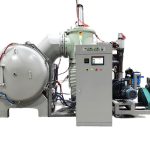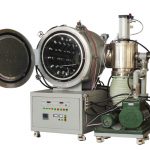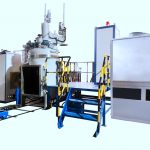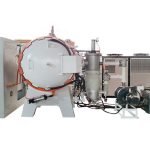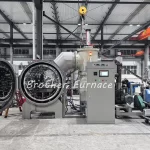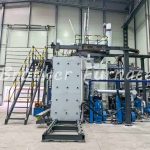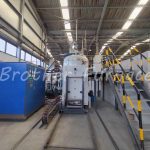

In January 2026, Brother Furnace completed the installation and commissioning of a 2 ton vacuum induction melting furnace (VIM furnace) for a specialty alloy manufacturer in Turkey.
The project started in late December 2025, when a five-engineer service team arrived at the customer’s production facility to carry out on-site installation. After mechanical assembly, vacuum system commissioning, and several trial melts, the industrial vacuum induction melting furnace was successfully put into operation on January 30, 2026.
The furnace is now operating as part of the customer’s production line for high-purity specialty alloy melting.
From 300 kg VIM Furnace to 2 Ton Industrial System
This project was a capacity upgrade rather than a first purchase.
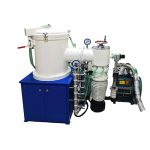
In 2024, the same manufacturer had already installed a 300 kg vacuum induction melting furnace supplied by Brother Furnace. After running the equipment reliably in daily production, the customer decided to expand their melting capacity and improve overall production efficiency.
The new 2 ton VIM furnace allows the company to significantly increase batch size while maintaining strict metallurgical quality standards.
For many specialty alloy producers, this type of expansion is typical: manufacturers often begin with a medium-capacity VIM furnace, and once the melting process is proven stable, they invest in larger industrial-scale equipment.

Installation and Commissioning Process
The installation and commissioning of the industrial vacuum induction melting furnace required more than one month of on-site work. During this period, the Brother Furnace engineering team completed several key tasks:
• Mechanical assembly and alignment of the vacuum furnace body and induction coil system
• Vacuum chamber sealing inspection and leak testing
• Commissioning of the vacuum pumping system, including mechanical pump, Roots blower, and diffusion pump
• Integration and load testing of the IGBT medium-frequency power supply
• Calibration of the furnace tilting and pouring mechanism
• Multiple trial melts using the customer’s production alloys
• Verification of melting performance, temperature control, and chemistry repeatability
• Operational training for production and maintenance personnel
After commissioning, the furnace achieved a stable working vacuum level of 7 × 10⁻³ Pa, meeting the process requirements for high-purity alloy melting.

Technical Specifications of the 2 Ton VIM Furnace
The system delivered to this Turkish customer belongs to Brother Furnace’s BR-RLL industrial vacuum induction melting furnace series, designed for large-scale alloy production.
| Parameter | Specification |
|---|---|
| Furnace capacity | 2,000 kg (steel equivalent) |
| Power | 800 – 1200 kW |
| Frequency | 500 – 800 Hz (IGBT medium frequency) |
| Maximum vacuum | 7 × 10⁻³ Pa |
| Maximum temperature | up to 1700°C |
This configuration is suitable for melting a wide range of high-performance materials, including:
-
specialty steels
-
nickel-based superalloys
-
cobalt-based alloys
-
high-purity engineering alloys
The vacuum induction melting furnace provides stable melting conditions, precise temperature control, and excellent metallurgical cleanliness.
Applications of Vacuum Induction Melting Furnaces in Specialty Alloy Production
A vacuum induction melting furnace is widely used in industries where alloy purity and composition control are critical.
Typical applications include:
-
aerospace alloy production
-
defense industry materials
-
high-temperature superalloys
-
precision engineering materials
-
research and advanced metallurgy
By melting materials in a controlled vacuum environment, a VIM furnace effectively reduces oxidation and contamination, allowing manufacturers to produce alloys with improved chemical consistency and mechanical performance.
Increasing Demand for VIM Furnaces in the Turkish Alloy Industry
Turkey’s specialty alloy and advanced manufacturing industries have expanded rapidly in recent years. As companies move toward higher-value products, many manufacturers are investing in industrial vacuum induction melting furnaces to improve metallurgical quality and production capability.
Installations like this 2 ton VIM furnace help alloy producers achieve more stable melting processes while supporting growing demand from aerospace, defense, and high-performance engineering sectors.
For more information about vacuum induction melting furnace systems, including models ranging from 5 kg laboratory furnaces to multi-ton industrial VIM furnaces, please visit: Vacuum Induction Melting Furnace Specifications
For a complete technical guide to VIM furnaces, see: Vacuum Induction Melting Furnace (VIM) Explained
Follow us on Facebook