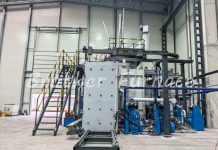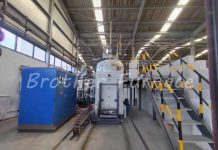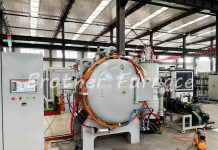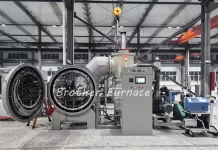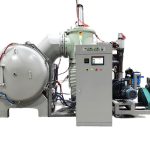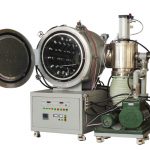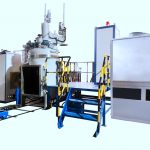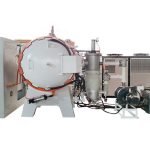
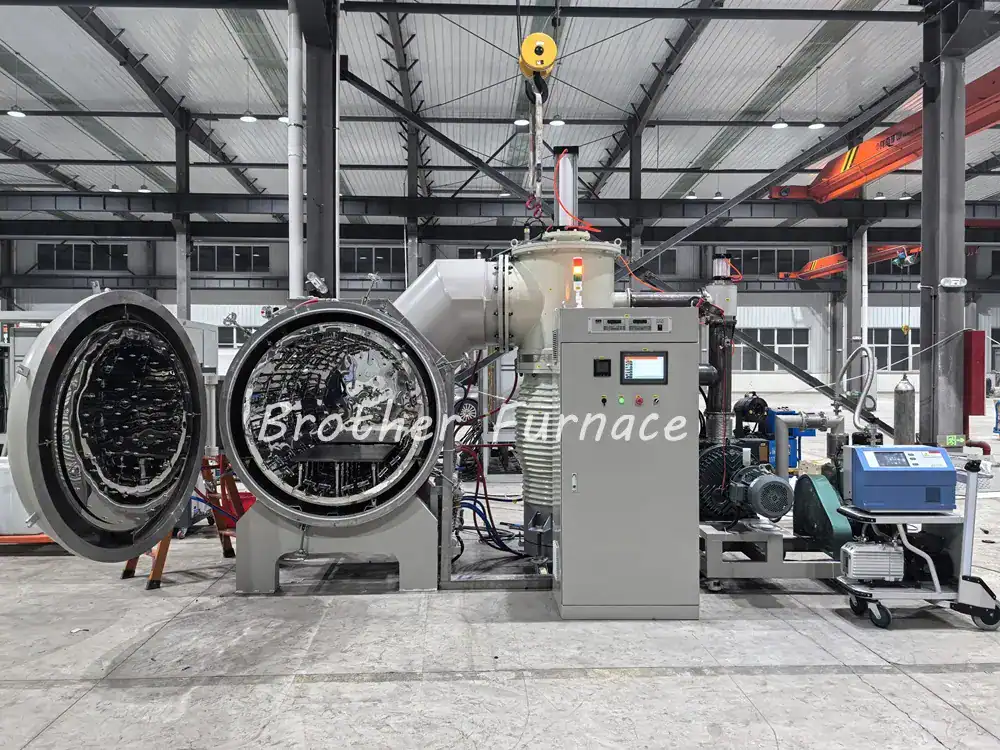
A vacuum brazing furnace is a high-precision thermal processing system that permanently joins metal components inside a sealed vacuum chamber. By eliminating oxygen and atmospheric contaminants, the furnace produces clean, flux-free brazed joints with exceptional strength and repeatability. Vacuum brazing is the preferred joining method in aerospace, automotive, cutting tool manufacturing, medical device production, and heat exchanger fabrication worldwide.
Vacuum brazing furnaces typically operate from 750°C up to 1350°C, with high-vacuum levels reaching 7×10⁻⁴ Pa. These systems are designed to support a wide range of brazing applications, including aluminum heat exchangers, stainless steel assemblies, and high-temperature nickel-based alloys.
What Is a Vacuum Brazing Furnace?
A vacuum brazing furnace heats metal assemblies in a controlled vacuum environment to a temperature above the brazing filler metal’s liquidus point, but below the base material’s melting point. The molten filler flows into precisely fitted joint gaps by capillary action, solidifies on cooling, and forms a strong metallurgical bond — without flux, without oxidation, and without post-braze cleaning.
The key differentiator from conventional brazing is the atmosphere: at vacuum levels of 10⁻³ to 10⁻⁴ Pa, oxide films on metal surfaces are chemically reduced or suppressed, allowing the filler metal to wet and flow freely. This is especially critical for materials like titanium alloys, nickel superalloys, and carbide tool bodies that cannot be brazed cleanly in air or inert gas.
How a Vacuum Brazing Furnace Works: Step-by-Step Process
1. Part Preparation and Assembly
All components are ultrasonically cleaned to remove oils, cutting fluids, and oxides. Joint clearances are precisely controlled — typically 0.025–0.127 mm (0.001–0.005 inches) for most filler metals — to ensure complete capillary fill. Filler metal is applied as foil, paste, or wire, positioned at or near the joint.
2. Loading and Chamber Evacuation
Assembled parts are loaded onto molybdenum or stainless steel fixtures and placed in the furnace chamber. The chamber is sealed and evacuated using a mechanical pump backed by a diffusion pump, reaching working vacuum levels of 7×10⁻³ Pa or better before heating begins. For moisture-sensitive materials, an initial outgassing hold at 150–200℃ is recommended.
3. Programmed Heating Cycle
The PLC temperature controller executes a pre-programmed multi-segment heating profile. Typical cycles include:
- Ramp-up phase: heating at ≤20℃/min to avoid thermal shock
- Intermediate hold(s): at 300–500℃ for outgassing, and at 50–80℃ below brazing temperature for temperature equalization across the load
- Brazing hold: typically 5–30 minutes at peak temperature, depending on filler metal and joint geometry
4. Brazing and Filler Flow
At brazing temperature, the filler metal melts and is drawn into the joint gap by capillary action. The vacuum environment ensures full wetting of base metal surfaces, producing porosity-free joints with tensile strength often exceeding the base material yield strength.
5. Controlled Cooling
Parts are cooled under vacuum or in a partial pressure of high-purity argon or nitrogen. Cooling rates are programmed to prevent quench cracking in brittle materials and to control distortion in precision assemblies. Parts exit the furnace bright, clean, and ready for use — no post-braze pickling or cleaning required.
Key Advantages of Vacuum Brazing Over Conventional Methods
| Parameter | Vacuum Brazing | Torch / Furnace Brazing (Air) |
|---|---|---|
| Atmosphere control | High vacuum (10⁻³–10⁻⁴ Pa) | Air or flux-protected |
| Flux required | No | Yes (most applications) |
| Post-braze cleaning | Not required | Required (flux removal) |
| Joint appearance | Bright, oxide-free | Discolored, requires cleaning |
| Distortion | Minimal (uniform heating) | Higher (localized heat) |
| Repeatability | Excellent (PLC program) | Operator-dependent |
| Complex / multi-joint parts | Yes — entire assembly in one cycle | Limited |
| Material compatibility | Ti, Ni, Co alloys, carbides, ceramics | Limited without special flux |
Industrial Applications of Vacuum Brazing Furnaces
Aerospace and Aviation Components
Vacuum brazing is the standard joining process for safety-critical aerospace assemblies that must survive extreme thermal cycling, vibration, and mechanical stress. Common applications include turbine blade cooling inserts, honeycomb sandwich panels for fuselage and nacelle structures, fuel nozzle assemblies, and plate-fin air-to-air heat exchangers.
Typical parameters: base materials — titanium alloys (Ti-6Al-4V), nickel superalloys (Inconel 625, Hastelloy X), stainless steel 321/347; filler metals — BNi-2 (Ni-7Cr-3Fe-4.5Si-3.1B, brazing temp 1010–1175℃), BNi-7 (Ni-14Cr-10P, 890–925℃); vacuum level ≤5×10⁻⁴ Pa.
CBN and PCD Cutting Tool Brazing
Polycrystalline cubic boron nitride (CBN) and polycrystalline diamond (PCD) inserts must be brazed to carbide or steel tool bodies without thermal degradation of the superhard material. Vacuum brazing with active Ag-Cu-Ti alloys forms a strong chemical bond via a TiC/TiN interfacial reaction layer, producing joint shear strengths exceeding 150 MPa.
Typical parameters: filler metal — Ag-Cu-Ti (e.g. 68.8Ag-26.7Cu-4.5Ti, liquidus 900℃); brazing temperature 820–870℃; hold time 10–20 min; vacuum ≤1×10⁻³ Pa. Applications include indexable milling inserts, boring bars, PCD-tipped turning tools, and CBN grinding segments.
Diamond Tools (Saw Blades, Core Drill Bits, Wire Saws)
Vacuum active brazing of synthetic diamond segments onto steel tool bodies produces a genuine chemical bond — titanium in the filler reacts with diamond carbon to form a thin TiC layer at the interface. Bond strength is 2–3× higher than conventional electroplated or sintered tools, dramatically improving tool life in granite, concrete, and ceramic cutting applications.
Typical parameters: filler — Ag-Cu-Ti active alloy; brazing temperature 820–900℃; vacuum ≤1×10⁻³ Pa; fixture material — graphite or molybdenum.
Automotive Heat Exchangers and EGR Coolers
Multi-pass stainless steel plate-and-fin heat exchangers for engine cooling, exhaust gas recirculation (EGR), and transmission oil cooling are brazed in vacuum furnaces using copper or nickel filler. Hundreds of joints across an entire assembly are completed simultaneously in a single furnace cycle, delivering consistent joint quality impossible to achieve by welding.
Typical parameters: base material — AISI 304/316L stainless steel; filler — copper paste (brazing temp 1100–1150℃) or BNi-2 nickel (1010–1175℃); furnace load — multiple assemblies per cycle; vacuum ≤5×10⁻³ Pa.
Brazed Plate Heat Exchangers (BPHE) for HVAC and Refrigeration
Vacuum copper-brazed stainless steel plate heat exchangers are mass-produced for HVAC, industrial process cooling, and refrigeration systems. The corrugated stainless steel plates are stacked with copper foil interleaved, then brazed in a single furnace cycle at 1080–1150℃. The resulting structure has no welds, no gaskets, and no mechanical fasteners — with all contact points permanently joined.
Stainless Steel and Nickel Alloy Precision Parts
Complex stainless steel assemblies — including manifolds, fluid distribution blocks, instrumentation housings, and multi-layer flow plates — are routinely vacuum brazed to eliminate the distortion and heat-affected zones associated with welding. Nickel-based filler metals (BNi series) are preferred for service temperatures above 500℃.
Medical Devices and Surgical Instruments
Surgical instruments, endoscope components, and implantable device assemblies require biocompatible, flux-free joints that can withstand repeated autoclave sterilization. Vacuum brazing with silver-based (BAg-8: 72Ag-28Cu) or gold-based filler metals meets ISO 13485 cleanliness requirements and produces corrosion-resistant joints in 316L stainless steel, titanium, and cobalt-chrome alloys.
Electronics: Ceramic-to-Metal Seals and Power Modules
High-vacuum feedthroughs, hermetic sensor housings, and power semiconductor module baseplates (copper or AlSiC bonded to DBC ceramic) are vacuum active-brazed using Ag-Cu-Ti alloys. The titanium activates the ceramic surface, allowing the filler to wet alumina (Al₂O₃), aluminum nitride (AlN), and zirconia (ZrO₂) substrates. Required vacuum level: ≤5×10⁻⁴ Pa to prevent ceramic delamination.
Vacuum Brazing Filler Metals: Selection Guide
| Filler Metal | Composition | Brazing Temp (℃) | Typical Application |
|---|---|---|---|
| BNi-2 | Ni-7Cr-3Fe-4.5Si-3.1B | 1010–1175 | Aerospace, stainless steel assemblies |
| BNi-7 | Ni-14Cr-10P | 890–925 | Thin-wall stainless, honeycomb panels |
| BAg-8 | 72Ag-28Cu | 780–900 | Stainless, medical devices, copper alloys |
| Ag-Cu-Ti (active) | 68.8Ag-26.7Cu-4.5Ti | 820–900 | CBN/PCD tools, diamond, ceramics |
| Copper (Cu) | >99.9% Cu | 1083–1150 | Stainless heat exchangers, BPHE |
| BAu-4 | 82Au-18Ni | 950–1000 | High-reliability aerospace, medical |
Vacuum Brazing Furnace: Types & Models
Brother Vacuum Brazing Furnaces cover three heating element and chamber configurations, designed to match the temperature range and material requirements of each application.

Full Technical Specifications
| Working Temperature Range | 750℃ (stainless chamber) / 1100℃ (ceramic fiber) / 1350℃ (molybdenum) / 1500℃ (custom) |
| Maximum Vacuum | 7×10⁻⁴ Pa |
| Working Vacuum | 7×10⁻³ Pa (mechanical pump + diffusion pump) |
| Temperature Accuracy | ±1℃ |
| Heating Rate | ≤20℃/min (programmable) |
| Temperature Control | 50-segment programmable PID / PLC, 30+ programs storable |
| Thermocouple | K type / S type |
| Touch Screen | 10-inch LED, heating curves saved and recalled |
| Alarms | Over-temperature, upper limit, deviation, broken thermocouple |
| Furnace Structure | Double-layer carbon steel casing with water cooling; surface temperature ≤30℃ |
| Power Supply | 380V 50Hz 3-phase (other standards available) |
| Power Range | 3 kW – 180 kW |
Stainless Steel Chamber — Up to 750℃ (BR-QHS Series)
Suitable for aluminum brazing, low-temperature silver alloy brazing, and soldering applications. The all-stainless steel hot zone provides excellent chemical resistance and easy cleaning.
| Model | Chamber Size | Max Temp. | Power | Max Vacuum |
|---|---|---|---|---|
| BR-QHS-223 | 200×200×300 mm | 750℃ | 12 kW | 7×10⁻³ Pa |
| BR-QHS-334 | 300×300×400 mm | 750℃ | 21 kW | 7×10⁻³ Pa |
| BR-QHS-446 | 400×400×600 mm | 750℃ | 34 kW | 7×10⁻³ Pa |
| BR-QHS-557 | 500×500×700 mm | 750℃ | 46 kW | 7×10⁻³ Pa |
| BR-QHS-669 | 600×600×900 mm | 750℃ | 64 kW | 7×10⁻³ Pa |
Ceramic Fiber Chamber — Up to 1200℃ (BR-200BF)
Lightweight ceramic fiber insulation for fast heat-up and cool-down cycles. Ideal for silver-based and copper-based filler metal applications, stainless steel parts, and R&D brazing trials.
| Model | Chamber Size | Max Temp. | Power | Max Vacuum |
|---|---|---|---|---|
| BR-200BF | Dia. 200×400 mm | 1200℃ | 8 kW | 7×10⁻³ Pa |
Molybdenum Chamber — Up to 1350℃ (BR-QHM Series)
Molybdenum strap heating elements and molybdenum hot-zone construction for high-temperature brazing of nickel superalloys, tool steels, and active metal brazing of ceramics. The standard series reaches 1350℃; custom configurations are available up to 1500℃.
| Model | Chamber Size | Max Temp. | Power | Max Vacuum |
|---|---|---|---|---|
| BR-QHM-223 | 200×200×300 mm | 1350℃ | 34 kW | 7×10⁻³ Pa |
| BR-QHM-334 | 300×300×400 mm | 1350℃ | 60 kW | 7×10⁻³ Pa |
| BR-QHM-446 | 400×400×600 mm | 1350℃ | 98 kW | 7×10⁻³ Pa |
| BR-QHM-557 | 500×500×700 mm | 1350℃ | 132 kW | 7×10⁻³ Pa |
| BR-QHM-669 | 600×600×900 mm | 1350℃ | 180 kW | 7×10⁻³ Pa |
Custom chamber sizes and 1500℃ configurations available on request.
Browse our full range of models, specifications and pricing on the Industrial Vacuum Brazing Furnace page.
Request a Quote or Technical Consultation
Brother Furnace engineers are available to advise on furnace model selection, chamber sizing, heating element configuration, and brazing process parameters for your specific application. Whether you are brazing aerospace honeycomb panels, CBN cutting tools, stainless heat exchangers, or ceramic-metal assemblies, we can recommend the right vacuum brazing furnace configuration.
Contact us for a customized solution →
Vacuum Brazing for Aluminum Components
Aluminum vacuum brazing requires especially precise temperature control because the brazing window is narrow — typically only 5–10℃ between filler liquidus and base metal solidus. The vacuum environment eliminates the tenacious aluminum oxide layer (Al₂O₃) that prevents filler wetting, removing the need for corrosive fluoride-based fluxes used in conventional CAB (controlled atmosphere brazing).
For dedicated aluminum brazing applications — including automotive heat exchangers, EV battery cooling plates, and HVAC evaporators — see our purpose-built Vacuum Aluminum Brazing Furnace.
How to Achieve High-Quality Brazed Joints
Joint quality in vacuum brazing depends on five critical factors: surface cleanliness, joint clearance control, filler metal selection, heating uniformity, and cooling rate. Poor surface preparation is the single most common cause of incomplete fill and void formation.
For a detailed process guide covering pre-braze cleaning procedures, joint design principles, fixture materials, and troubleshooting common defects, see: Vacuum Brazing: How to Achieve High-Quality Brazed Joints.
Frequently Asked Questions
What metals can be brazed in a vacuum brazing furnace?
Stainless steel (300 and 400 series), nickel and cobalt superalloys, titanium alloys, copper and copper alloys, tool steels, tungsten carbide, and ceramics (with active filler metals) can all be vacuum brazed. The key requirement is selecting the correct filler metal and brazing temperature for each base material combination.
What vacuum level is required for brazing?
Most metals braze well at 10⁻³ Pa working vacuum. Reactive metals (titanium, active ceramic brazing) and high-temperature nickel superalloy applications require 10⁻⁴ Pa or better. Brother furnaces achieve a maximum vacuum of 7×10⁻⁴ Pa using a mechanical pump and diffusion pump combination.
Can I braze CBN and PCD inserts in a vacuum brazing furnace?
Yes. CBN and PCD tools require active Ag-Cu-Ti filler metals and a vacuum of ≤1×10⁻³ Pa. The titanium in the filler reacts with the CBN or diamond surface to form a strong chemical bond. Brother molybdenum chamber furnaces (BR-QHM series, up to 1350℃) are well suited to this application.
What is the difference between a vacuum brazing furnace and an atmosphere brazing furnace?
A vacuum brazing furnace removes all gas from the chamber, relying on the vacuum itself to prevent oxidation. An atmosphere furnace replaces air with an inert or reducing gas (nitrogen, hydrogen, argon). Vacuum brazing offers lower residual oxygen levels, no risk of gas contamination, and is preferred for reactive metals, precision components, and any application where surface cleanliness is critical.
How long does a vacuum brazing cycle take?
Total cycle time depends on part mass, the temperature program, and the required vacuum level. A typical cycle for a small-to-medium load is 3–6 hours: approximately 1 hour for evacuation and ramp-up, 10–30 minutes at brazing temperature, and 1–3 hours for controlled cooling to handling temperature. Larger loads and higher temperatures extend cycle times.
Can I braze multiple parts or assemblies simultaneously?
Yes. One of the major productivity advantages of vacuum brazing is the ability to load an entire batch — multiple parts or assemblies — and complete all joints in a single furnace cycle. Proper fixture design and spacing are important to ensure uniform temperature distribution throughout the load.
What chamber size do I need?
Chamber size is determined by the dimensions of your largest part or fixture plus clearance for thermal expansion and gas flow. Brother furnaces range from 200×200×300 mm to 600×600×900 mm as standard, with larger custom chambers available. Contact our engineering team with your part dimensions and production volume for a recommendation.
Follow us on Facebook