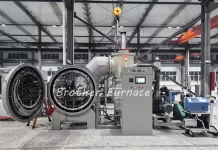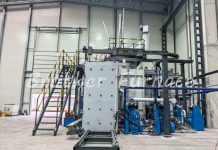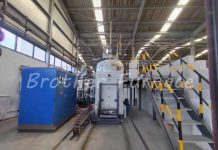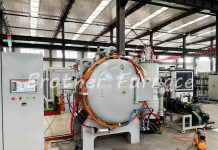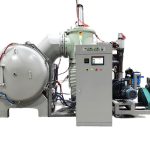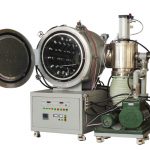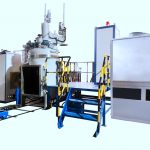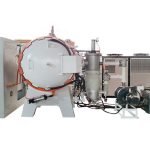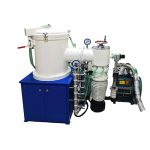

Vacuum aluminum brazing is a high-precision, fluxless joining process conducted within a precisely controlled furnace environment. It is the preferred method for manufacturing critical components in industries such as aerospace, automotive, and heat exchangers, where joint integrity, corrosion resistance, and cosmetic appearance are paramount.
Process Temperature
The brazing of aluminum and its alloys requires a tightly controlled temperature profile. Unlike processes for steel or tools that may operate above 1000°C, aluminum brazing occurs at a significantly lower, yet critical, temperature range.
- Typical Brazing Range: 580°C to 620°C (1076°F to 1148°F)
- Process Control: The furnace must heat the workload uniformly to a temperature just above the liquidus temperature (the point of being fully molten) of the brazing filler metal (e.g., Al-Si based alloys like AA4047, liquidus at ~577°C) but safely below the solidus temperature (the point of beginning to melt) of the base aluminum alloy (e.g., AA3003, AA6061). Precise temperature control and uniformity (±3°C to ±5°C) across the workload are essential to prevent melting of the base material while ensuring complete filler metal flow.
Filler Metal and Application
While the process temperature is defined by the alloys, the application of the filler metal is key to production. It can be applied as pre-placed wire, shims, or paste. However, for high-volume production (e.g., heat exchangers), the most common method is the use of braze-clad sheet. This is a composite material where the base alloy (e.g., 3003) is pre-bonded with a thin layer of the filler alloy (e.g., 4047) on one or both sides.
Furnace Heating Element Selection
For vacuum brazing furnaces dedicated specifically to Nichrome heating elements are typically the preferred choice for heating elements, offering an optimal balance of cost-effectiveness and thermal performance.
Furnace Chamber Selection
Stainless steel hot zone insulation and Multi-sided heating zones for precise temperature control.
Vacuum System
Larger pumping system designed to handle magnesium burst during the brazing process. High vacuum = high braze quality.
Vacuum Level (Vacuum Degree)
A high-quality vacuum environment is the cornerstone of the process, serving multiple critical functions.
- Required Vacuum Level: A process vacuum level in the range of 10-2 Pa to 10-4 Pa is typical, with a target in the 10-3 Pa range being common. The critical factor is not the absolute pressure, but the low partial pressure of oxygen and water vapor.
- Primary Functions:
- Prevention of Re-Oxidation: The primary function of the vacuum is to remove ambient oxygen and water vapor. This prevents the aluminum parts from forming a new, thick, inhibitory oxide layer as they are heated to brazing temperature.
- Enabling the ‘Getter’ Action: The vacuum environment is essential for enabling the mechanisms that break down the existing native oxide layer, as described below. It creates the clean atmosphere needed for the “getter” to work.

See the technical details of our Vacuum Aluminum Brazing Furnace
The Critical Role of Magnesium (Mg) as a Getter
- Getter Action: At brazing temperatures and in a vacuum, Mg (often introduced via the filler metal or as a separate “getter” material) has a high vapor pressure and sublimes (vaporizes). This Mg vapor acts as a “getter,” actively reacting with and “scavenging” any residual oxygen and water vapor in the furnace, further purifying the atmosphere.
- Oxide Disruption: More importantly, the Mg vapor chemically interacts with and disrupts the integrity of the tenacious oxide layer on the parts.
- Wetting: This disruption (not complete removal) is what allows the molten Al-Si filler metal to penetrate the compromised oxide, wet the base aluminum underneath, and flow into the joint via capillary action.
This is why a small, controlled amount of Mg is essential to the process, but also why base alloys with high Mg content (like the 5xxx series) are detrimental, as they form their own stable oxides that interfere.
Key Advantages of Vacuum Aluminum Brazing
- Oxide-Free, Bright Surfaces: Components emerge with a clean, bright, metallurgically pure finish.
- Fluxless and Environmentally Friendly: Eliminates the cost, cleanup, and potential corrosion issues associated with flux residues.
- Minimal Part Distortion: The uniform heating and slow, controlled cooling cycles minimize thermal stresses.
- Superior Joint Quality: Produces strong, leak-tight, and reliable joints with excellent repeatability.
- Complex Geometries: Capable of brazing complex and multi-layer assemblies (like plate heat exchangers) in a single operation.
Contact us now for a custom quote or free consultation.
FAQ
Q1: What are the critical phases of a vacuum brazing cycle?
A1: A typical cycle consists of:
- Loading: Parts are assembled with filler metal pre-placed.
- Pump-down: The chamber is evacuated to a high vacuum.
- Heating & Soaking: A controlled ramp to a temperature below the filler metal melt point (e.g., 550°C) is held to ensure thermal uniformity and allow outgassing.
- Brazing Soak: Temperature is raised into the brazing range (580-620°C) and held to allow filler metal melting and capillary flow.
- Controlled Cooling: The furnace cools at a controlled rate to solidify the joint. Many modern furnaces use high-pressure gas cooling (e.g., with Nitrogen) to accelerate this phase. This shortens the cycle time and, for 6xxx series alloys (like 6061), can provide a solution heat treatment effect crucial for subsequent artificial aging (T4/T6).
- Backfill & Unload: The chamber is backfilled with inert gas (e.g., Nitrogen) to atmospheric pressure for part unloading.
Q2: Can all aluminum alloys be vacuum brazed?
A2: No. Successful brazing requires careful selection.
- Good: Base alloys like the 3xxx (Al-Mn) and 6xxx (Al-Mg-Si) series are commonly used.
- Difficult: Alloys with high magnesium content (e.g., 5xxx series) are very difficult to braze, as the high Mg content interferes with the process by forming excessive, stable oxides, as explained in the section on the role of magnesium.
More Vacuum Furnace:
Follow us on Facebook