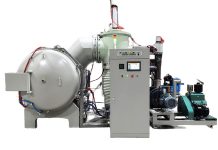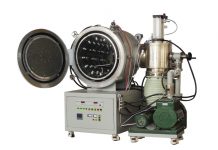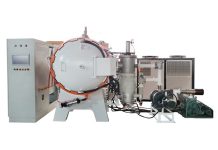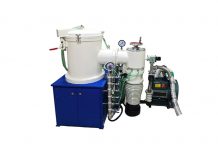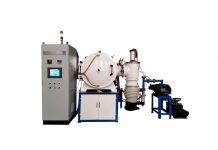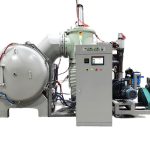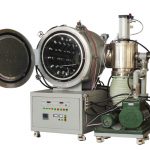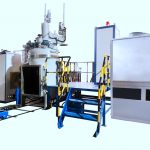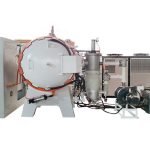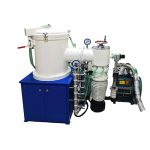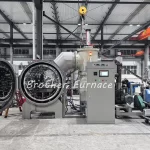

AI Liquid Cold Plate Vacuum Brazing Furnace solutions are becoming essential as artificial intelligence computing, high-performance servers, and hyperscale data centers continue to expand rapidly. Liquid cooling has evolved into a critical infrastructure technology, and independent liquid cold plates now impose extremely demanding requirements on brazing quality, reliability, and long-term operational stability.
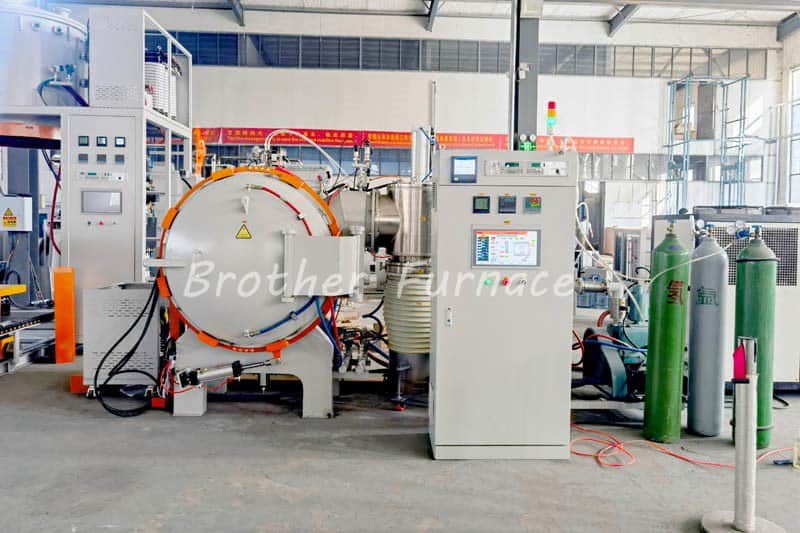
To address these challenges, we have developed a new AI Liquid Cold Plate Vacuum Brazing Furnace, purpose-built for high-precision, high-temperature, and ultra-high vacuum brazing applications, ensuring consistent performance for advanced liquid cooling systems.
High Quality Requirements for AI Liquid Cold Plate Brazing
Modern AI liquid cooling plates require brazing processes that go far beyond the capabilities of conventional vacuum brazing furnaces. Key technical requirements include:
- Ultra-high brazing temperature: up to 1200°C and above
- Smooth and clean brazed surfaces, suitable for high-flow liquid cooling channels
- Exceptional hermeticity:
≤ 1 × 10⁻⁶ Pa·m³/s, verified by helium mass spectrometry leak detection - High mechanical strength:
Shear strength ≥ 60 MPa - High pressure resistance:
Operating pressure ≥ 1.5 MPa - Excellent thermal cycling durability for long-term, high-load operation
Standard vacuum brazing furnaces often struggle to achieve stable temperature uniformity, ultra-low vacuum levels, and low outgassing rates simultaneously—making them unsuitable for advanced AI liquid cold plate manufacturing.
New AI Liquid Cold Plate Vacuum Brazing Furnace
To address these challenges, our engineering team has developed a dedicated vacuum brazing furnace for AI liquid cooling plates, designed for applications in AI computing, semiconductor manufacturing, data centers, and advanced electronics.
This system integrates high-temperature capability, precise thermal control, and ultra-clean vacuum performance into a single, production-ready solution.
Key Features and Technical Advantages
Ultra-High Temperature Capability
- Maximum operating temperature: 1350 °C
- Fully compatible with high-temperature vacuum brazing processes for copper, stainless steel, nickel-based alloys, and advanced composite structures
Multi-Zone Precision Temperature Control
- At least 3 independent heating zones
- Temperature uniformity: ±3 °C
- Segmented temperature monitoring from 500 °C to 1250 °C
- Ensures uniform brazing quality across complex liquid cold plate geometries
Advanced Ultra-High Vacuum System
- Ultimate vacuum: 8 × 10⁻⁴ Pa
- Working vacuum: 4 × 10⁻⁴ Pa
- Vacuum system configuration: Mechanical pump + Roots pump + Diffusion pump or turbomolecular pump
- Equipped with high-vacuum isolation valves and cold traps for maximum cleanliness and stability
Extremely Low Pressure Rise Rate
- Pressure rise rate ≤ 0.3 Pa/h after furnace degassing
- Minimizes internal defects, voids, and contamination during brazing
Inert Gas Rapid Cooling
- Supports inert gas backfilling and forced cooling
- Improves metallurgical properties
- Significantly increases production efficiency and throughput
Customized High-Temperature Alloy Fixtures
- Personalized fixture design using high-temperature superalloys
- Stable part positioning
- High loading capacity for batch production
- Optimized for complex liquid cooling plate assemblies
Premium Components
- Electrical systems, instruments, and vacuum components sourced from leading international brands
- Ensures long-term stability, repeatability, and low maintenance cost
Applications
- AI liquid cooling plates
- High-density data center cooling modules
- Semiconductor thermal management components
- Power electronics cooling systems
- Advanced 3C electronics thermal solutions
Proven Performance in AI and Semiconductor Applications
This AI liquid cold plate vacuum brazing furnace has already been deployed by well-known AI and semiconductor manufacturers, where it is used for brazing liquid cooling pipes, cold plates, and connectors.
Customers feedback:
- Excellent brazing consistency
- Reliable leak-free joints
- High mechanical strength
- Stable long-term operation under demanding thermal cycles
These results mark a significant technological breakthrough in high-precision vacuum brazing for liquid cooling systems.
AI Liquid Cold Plate Vacuum Brazing Furnace Technical Specifications
| Model | BR-QHM-669 | BR-QHM-8812 |
| Hot Zone Size (W × H × D) | 600 × 600 × 900 mm | 800 × 800 × 1200 mm |
| Maximum Loading Capacity | 800 kg | 1800 kg |
| Maximum Operating Temperature | 1350 °C | |
| Continuous Operating Temperature | ≤ 1300 °C | |
| Power Supply & Rated Power | 380 V, 3-phase; Total power 230 kW; Heating power 180 kW; Rapid cooling fan 15 kW | |
| Furnace Structure | Double-layer water-cooled chamber; Inner shell: SUS304 polished mirror-finish stainless steel; Outer shell: Q345 high-strength carbon steel | |
| Temperature Zones | 3-zone control: front door, rear door, furnace body independently controlled | 4-zone control: front door, rear door, furnace body (2 sections) independently controlled |
| Ultimate Vacuum | 8 × 10⁻⁴ Pa (empty, cold state, after purification) | |
| Working Vacuum | 4 × 10⁻³ Pa (empty, after purification; actual value affected by product outgassing) | |
| Pressure Rise Rate | ≤ 0.3 Pa/h (after sufficient degassing) | |
| Temperature Control Accuracy | ± 1 °C | |
| Temperature Uniformity | ± 3 °C (measured at 500, 700, 850, 1000, 1150, 1250 °C) | |
| Temperature Measurement Method | Type K thermocouples below 1000 °C; temperature ring above 1000 °C | |
| Heating Rate | Adjustable: 0–20 °C/min | |
| Recommended Heating Rate (<1000 °C) | ≤ 10 °C/min | |
| Recommended Heating Rate (1000–1300 °C) | ≤ 5 °C/min | |
| Rapid Cooling System | Nitrogen gas cooling; heat exchanger; 15 kW; cooling pressure 2 bar | |
| Cooling Performance | 500 °C to room temperature in approx. 40–45 minutes | |
| Thermocouples | Control thermocouple: Type S ×1; Over-temperature alarm thermocouple: Type S ×1 | |
| Thermocouple Protection Tube | 99.7% purity alumina (corundum) tube | |
| Heating Elements & Hot Zone | High-temperature molybdenum–lanthanum alloy strips with reinforced edge clamping; no deformation at high temperature | |
| Thermal Insulation | Inner 4 layers of high-purity molybdenum; outer 4 layers of 310S heat-resistant stainless steel | |
| Temperature Control System | EUROTHERM controllers (UK), 0.1 accuracy class; Programmable PID control with up to 50 segments | |
| Power Regulation | Digital power regulator modules with precise voltage control and current limiting protection | |
| Control & Protection | Linear current output; phase-angle triggered anti-parallel thyristors; over-temperature and thermocouple break alarm | |
| Electrical Components | Schneider, ABB and other first-tier international brands | |
| Human–Machine Interface (HMI) | 15-inch LCD touchscreen; programmable; 512 MB memory; built-in Ethernet; expandable wireless networking; mobile APP remote control | |
| Vacuum System | Mechanical pump + Roots pump + diffusion pump (imported brands); diffusion pump equipped with dedicated high-vacuum valve and cold trap; 304 stainless steel vacuum piping with flexible connections; composite digital vacuum gauges | |
| Gas Circuit | One inlet and one outlet; overpressure solenoid valve auto-opening; parallel mechanical pressure relief valve as backup | |
| Water Cooling System | Stainless steel pipelines, pressure-resistant and explosion-proof; water pressure, flow, and temperature monitoring with audible and visual alarms | |
| Loading / Unloading | Automatic charging trolley with customized fixtures | |
A Reliable Partner for Advanced Vacuum Brazing Technology
With continuous innovation in high-precision vacuum brazing and liquid cooling manufacturing, we are committed to delivering high-performance vacuum brazing furnaces and complete technical solutions for:
- Artificial intelligence computing
- Hyperscale data centers
- Semiconductor and electronics industries
If you are looking for a vacuum brazing furnace for AI liquid cold plates that meets the most demanding quality standards, or require technical consultation for your brazing process, please contact us to discuss your application requirements.
FAQs – AI Liquid Cold Plate Vacuum Brazing Furnace
Ultra-high vacuum is essential to prevent oxidation and contamination during brazing. For AI liquid cold plates, a working vacuum around 4 × 10⁻³ Pa ensures proper wetting of the brazing filler metal, minimizes porosity, and achieves helium leak rates ≤ 1 × 10⁻⁶ Pa·m³/s, which is mandatory for high-pressure liquid cooling systems.
High-quality brazing typically requires: Ultimate vacuum: ~8 × 10⁻⁴ Pa Stable working vacuum: ~4 × 10⁻³ Pa If vacuum levels fluctuate due to outgassing or insufficient pumping capacity, internal defects and micro-leaks are more likely to occur.
Liquid cold plates often have large surface areas and complex internal channels. Multi-zone heating (3–4 zones) ensures temperature uniformity within ±3 °C, reducing thermal gradients that can cause warping, uneven filler flow, or incomplete brazing.
A low pressure rise rate (≤ 0.3 Pa/h after degassing) indicates a clean furnace environment and low residual gas release. This directly correlates with: Reduced internal voids Higher joint density Improved mechanical strength and long-term reliability
Brazed AI liquid cold plates are typically verified using: Helium mass spectrometer leak testing Pressure or hydraulic testing Mechanical shear strength testing These tests ensure the product meets strict requirements for pressure resistance, thermal cycling, and long-term operation. Why is ultra-high vacuum critical for AI liquid cold plate brazing?
What vacuum level is required to achieve reliable, leak-free brazed joints?
Why is multi-zone temperature control important for liquid cold plates?
How does pressure rise rate affect brazing quality?
How is brazing quality verified after production?