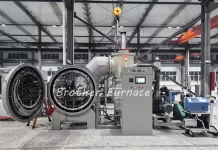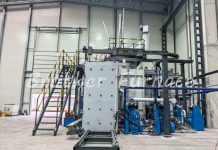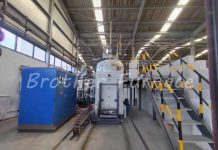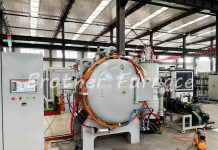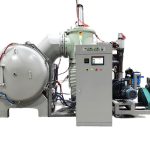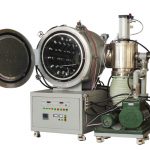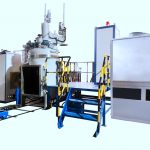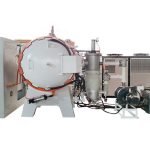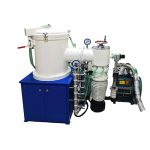
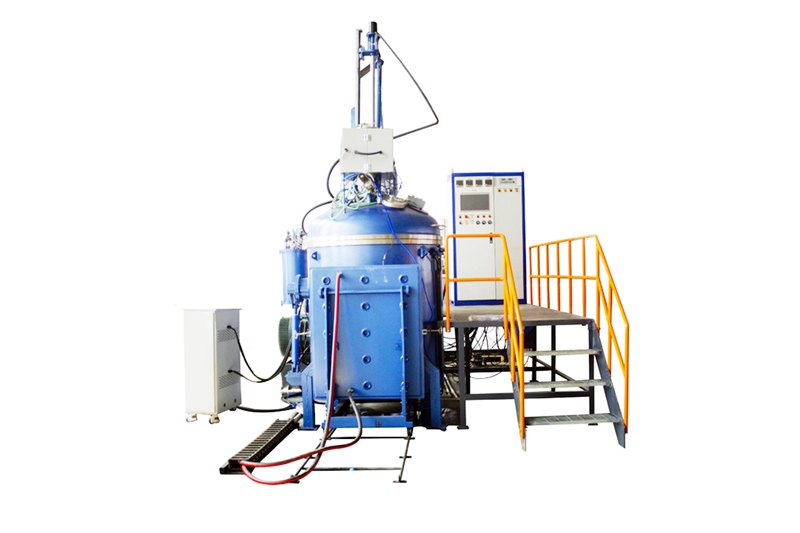
An induction heated vacuum furnace — also called a vacuum induction melting furnace (VIM) — uses electromagnetic induction to melt metal inside a sealed, evacuated chamber. The vacuum environment prevents oxidation and gas contamination, while induction heating delivers precise temperature control and efficient energy transfer directly into the metal charge. The result is high-purity alloys with dissolved oxygen below 20 ppm and tight compositional control of reactive elements — impossible in open-air furnaces.
Induction heated vacuum furnaces are the standard production tool for nickel-based superalloys, titanium alloys, maraging steels, rare-earth permanent magnets, and zirconium alloys across aerospace, medical, automotive, and energy industries.
How an Induction Heated Vacuum Furnace Works
An alternating current at medium frequency (500–3000 Hz) passes through a water-cooled copper coil surrounding the crucible. This generates a time-varying magnetic field which — by Faraday’s Law — induces circulating eddy currents directly within the conductive metal charge. The electrical resistance of the metal converts these currents into heat internally, uniformly, and without any physical contact between a heating element and the melt.
Two effects occur simultaneously:
- Contactless heating: No electrode material can dissolve into the melt, unlike arc furnaces.
- Electromagnetic stirring (pinch effect): Lorentz force interaction between eddy currents and the magnetic field creates continuous toroidal circulation in the liquid metal — automatic homogenization without mechanical paddles.
The sealed chamber is evacuated to 7×10⁻³ Pa or lower before heating begins. At this pressure, dissolved oxygen and nitrogen are pulled out of the liquid metal by the partial pressure gradient, hydrogen solubility drops sharply, and volatile trace impurities (Pb, Bi, Sb) reach their vapor pressure and evaporate entirely.
Key Components of an Induction Heated Vacuum Furnace
- Induction Coil: Rectangular copper tubing, internally water-cooled. Carries the medium-frequency alternating current that generates the magnetic field. The coupling gap between coil and crucible is minimized to maximize heating efficiency.
- Crucible: Sits concentrically inside the induction coil and holds the metal charge. Material selection depends on alloy chemistry and temperature — see crucible selection guide below.
- Vacuum Chamber: Double-walled, water-cooled steel vessel sealed with metal O-rings or elastomer seals at all flanges, windows, and feedthrough penetrations. Surface temperature kept below 50°C by water cooling.
- Vacuum System: Multi-stage pump train — mechanical roughing pump (atmosphere to ~10 Pa), Roots blower (~10 Pa to ~0.1 Pa), oil diffusion pump (final vacuum to 7×10⁻³ Pa). Maximum achievable vacuum: 7×10⁻⁴ Pa.
- Furnace Tilting Mechanism: Rotates the furnace body to pour the molten metal into molds positioned below the crucible, under vacuum or argon backfill.
- IGBT Medium-Frequency Power Supply: Solid-state inverter operating at 500–3000 Hz. Provides stepless power control from near-zero to full output with >92% electrical efficiency. IGBT is preferred over older KGPS (thyristor) supplies for all new installations.
- Electrical Control System: PLC-based sequencing with touch-screen HMI. Controls power, temperature, vacuum level, tilt angle, and alloy feeder timing. Full data logging for batch traceability.
- Vacuum-Locked Alloy Feeder: Multi-hopper system (typically 3–5 hoppers) for adding reactive elements (Al, Ti, B, Zr) into the melt without breaking vacuum.
Induction Heated vs. Resistance Heated Vacuum Furnace
Both are vacuum furnaces, but they serve fundamentally different purposes. The choice depends on whether the application requires melting and casting, or heat treatment and sintering.
| Feature | Induction Heated Vacuum Furnace | Resistance Heated Vacuum Furnace |
|---|---|---|
| Heat generation | Eddy currents induced directly in the metal charge | Resistance elements (MoSi₂, graphite, Mo strap) radiate heat to the load |
| Heating rate | Very fast — heat generated inside the metal itself | Slower — heat transferred from element to load surface |
| Temperature uniformity | Excellent in liquid state due to electromagnetic stirring | Excellent across the hot zone for solid loads |
| Efficiency | 80–92% (IGBT power supply) | 60–80% (radiant heat transfer losses) |
| Primary application | Melting, refining, and casting reactive alloys | Heat treatment, sintering, brazing, annealing |
| Electromagnetic stirring | Yes — automatic, contact-free | No |
| Capital cost | Higher | Lower for equivalent hot zone volume |
| Typical max. temperature | Up to 2000°C | Up to 2200°C (graphite element) |
Rule of thumb: If you need to melt metal and control its chemistry under vacuum, use an induction heated vacuum furnace. If you need to heat treat, sinter, or braze solid components under vacuum, use a resistance heated vacuum furnace.
→ View Brother Furnace induction heated vacuum furnace specifications
Operating Temperature Range
Induction heated vacuum furnaces cover a wide temperature range depending on crucible and coil configuration:
- Standard production range: 1000–1700°C — covers all nickel superalloys, cobalt alloys, steels, and stainless steels
- Titanium and reactive metals: 1650–1800°C with zirconia or calcia crucibles
- Maximum capability: up to 2000°C with custom high-temperature coil configuration
Key Advantages
| Advantage | Technical Basis | Measurable Result |
|---|---|---|
| Oxygen and nitrogen removal | Partial pressure gradient drives dissolved gases out of liquid metal under vacuum | O <20 ppm, N <10 ppm (vs. >100 ppm in air melting) |
| Reactive element control | No atmospheric oxidation of Al, Ti, B, Zr during melting | Ti/Al composition held to ±0.05–0.12% (vs. ±0.3% in air) |
| Volatile impurity removal | Pb, Bi, Sb, Se, Te reach vapor pressure and evaporate under vacuum | Grain-boundary embrittling elements removed — no other process achieves this |
| High thermal efficiency | Heat generated directly in the metal charge by eddy currents | 80–92% efficiency with IGBT power supply |
| Chemical homogeneity | Electromagnetic stirring (pinch effect) circulates the melt continuously | Uniform composition throughout the melt without mechanical stirring |
| Low environmental impact | Sealed vacuum chamber contains all fumes and dust | No combustion gases, no open metal surface emissions |
Crucible Selection Guide
Crucible selection is the most consequential materials decision in induction heated vacuum furnace operation. An incompatible crucible contaminates the melt in ways the vacuum cannot correct.
| Crucible Material | Max. Temp. | Suitable Alloys | Avoid With |
|---|---|---|---|
| Magnesia (MgO) | >1800°C | Ni-based superalloys, Co-based alloys, steels, Fe-Ni alloys | Alloys with Al >6% |
| Alumina (Al₂O₃) | ~1750°C | Stainless steels, low-Al alloys, Cu alloys | Ti-rich alloys, alloys with Al >4% — Al reduces the crucible wall |
| Zirconia (ZrO₂) | >2000°C | Ti alloys, Co-based alloys, Pt-group metals | High-Si alloys; requires Y₂O₃ or CaO stabilizer |
| Calcia (CaO) | ~1800°C | High-Al titanium alloys, reactive alloys where MgO is marginal | Moisture exposure — hydrates rapidly, must be kept dry |
| Graphite (C) | >2500°C | Cu alloys, precious metals under inert backfill only | Steel, Ni alloys in vacuum — carbon contamination is inevitable |
Industrial Applications
Aerospace: Nickel-based superalloys for turbine blades, discs, and vanes (IN718, Waspaloy, MAR-M247, CMSX-4). VIM chemistry control of Al/Ti/Ta ratios is critical for γ/γ′ microstructure in single-crystal alloys.
Medical: Cobalt-chromium implants (CoCrMo per ASTM F75) and titanium alloys (Ti-6Al-4V ELI per ASTM F136). Oxide-free microstructure improves fatigue life and reduces particulate debris in joint replacements.
Automotive and Energy: High-performance valve steels, maraging steels, and NdFeB/SmCo permanent magnet master alloys for EV motors and wind turbine generators.
Nuclear: Zirconium alloys (Zircaloy-2, Zircaloy-4) for fuel cladding — requires hafnium content below 100 ppm, achievable only by VIM under high vacuum with calcia or zirconia crucibles.
Specialty metals: VAR and ESR electrode production, investment casting master alloys, reactive metals (zirconium, hafnium, niobium) under specific process conditions.
Standard Model Specifications
| Model | Capacity (kg) | Frequency (Hz) | Power (kW) | Max. Vacuum (Pa) | Cooling Water (T/H) |
|---|---|---|---|---|---|
| BR-RLL-10 | 10 | 3000 | 60 | 7×10⁻³ | 10 |
| BR-RLL-25 | 25 | 2500 | 120 | 7×10⁻³ | 15 |
| BR-RLL-50 | 50 | 2000 | 160 | 7×10⁻³ | 25 |
| BR-RLL-100 | 100 | 2000 | 200 | 7×10⁻³ | 30 |
| BR-RLL-200 | 200 | 1000 | 200 | 7×10⁻³ | 35 |
| BR-RLL-300 | 300 | 800 | 250 | 7×10⁻³ | 40 |
| BR-RLL-500 | 500 | 800 | 350 | 7×10⁻³ | 50 |
| BR-RLL-1000 | 1000 | 800 | 400 | 7×10⁻³ | 70 |
Custom capacities and configurations available on request. Capacity ratings are for steel (density ~7.9 g/cm³) — titanium alloy capacity is approximately 57% of the rated steel capacity for the same crucible volume.
Case study: 2-ton induction heated vacuum furnace installation in Turkey (2026)
Troubleshooting and Maintenance
Melt leakage: Most commonly caused by crucible cracking from thermal shock or incompatible alloy chemistry. Always preheat crucibles according to the sintering schedule, and verify crucible-alloy compatibility before the first heat in any new grade.
Slow pump-down or insufficient vacuum: Check O-ring seals at all chamber flanges, observation windows, and feedthrough penetrations first — a single worn seal can raise base pressure by an order of magnitude. Also check diffusion pump oil condition and cold trap cleanliness.
Inaccurate temperature control: Caused by thermocouple drift, contamination, or incorrect placement. Calibrate thermocouples regularly and verify that the pyrometer sight path through the observation window is clean and unobstructed.
Routine maintenance checklist: inspect water cooling circuits for flow and temperature; check vacuum pump oil level and condition; clean chamber interior of metal spatter after each heat; inspect induction coil for cracks or insulation degradation; verify feeder hopper seals and valve operation.
Frequently Asked Questions
What is the difference between an induction heated vacuum furnace and a vacuum induction melting furnace?
They are the same equipment referred to by different names. 'Induction heated vacuum furnace' describes the heating method; 'vacuum induction melting furnace (VIM)' describes the primary application. Both terms refer to a sealed, evacuated furnace that uses electromagnetic induction to melt metal.
What metals can be melted in an induction heated vacuum furnace?
Nickel-based and cobalt-based superalloys, maraging steels, premium tool steels, stainless steels, titanium alloys, zirconium alloys, rare-earth permanent magnet alloys (NdFeB, SmCo), and other reactive metals. Any alloy containing Al, Ti, B, Zr, or Nb — elements that oxidize rapidly in air — requires an induction heated vacuum furnace to achieve the required purity and compositional precision.
What vacuum level is required?
Most alloys are processed at 7×10⁻³ Pa working vacuum. Reactive metals (titanium, zirconium) and life-critical aerospace applications may require 10⁻⁴ Pa or better. Brother furnaces achieve a maximum vacuum of 7×10⁻⁴ Pa using a mechanical pump, Roots blower, and diffusion pump combination.
What is the difference between IGBT and KGPS power supplies?
IGBT (Insulated Gate Bipolar Transistor) solid-state inverters provide stepless power control from near-zero to full output, over 92% electrical efficiency, and precise frequency adjustment. KGPS (thyristor-based) supplies are older technology — still functional but offer less fine control and lower efficiency. Specify IGBT for all new installations.
How do I choose the right crucible?
Match crucible chemistry to your alloy. Magnesia (MgO) for most nickel superalloys and steels. Alumina (Al₂O₃) for stainless steels and low-Al alloys — never use with alloys over 4% Al. Zirconia (ZrO₂) for titanium alloys and high-temperature melts. Calcia (CaO) for high-Al titanium alloys. Graphite only for copper alloys under inert backfill — never in vacuum for steel or nickel alloys.
How long does a melt cycle take?
A typical cycle for a 25–100 kg charge takes 2–4 hours: 30–60 minutes evacuation, 30–90 minutes melting and refining, 15–30 minutes alloying and composition adjustment, 10–20 minutes casting and cool-down. Larger furnaces (300 kg–1 ton) require 3–6 hours per cycle.
Related Technical Resources
- Vacuum Induction Melting Furnace (VIM) Explained: Engineering Guide — detailed equipment guide covering types, vacuum system design, and specification checklist
- What is Vacuum Induction Melting? A Complete Process Guide — 7-stage process walkthrough, VIM vs. VAR vs. ESR, and alloy application guide
- View VIM Furnace Product Specifications →